
 "
"
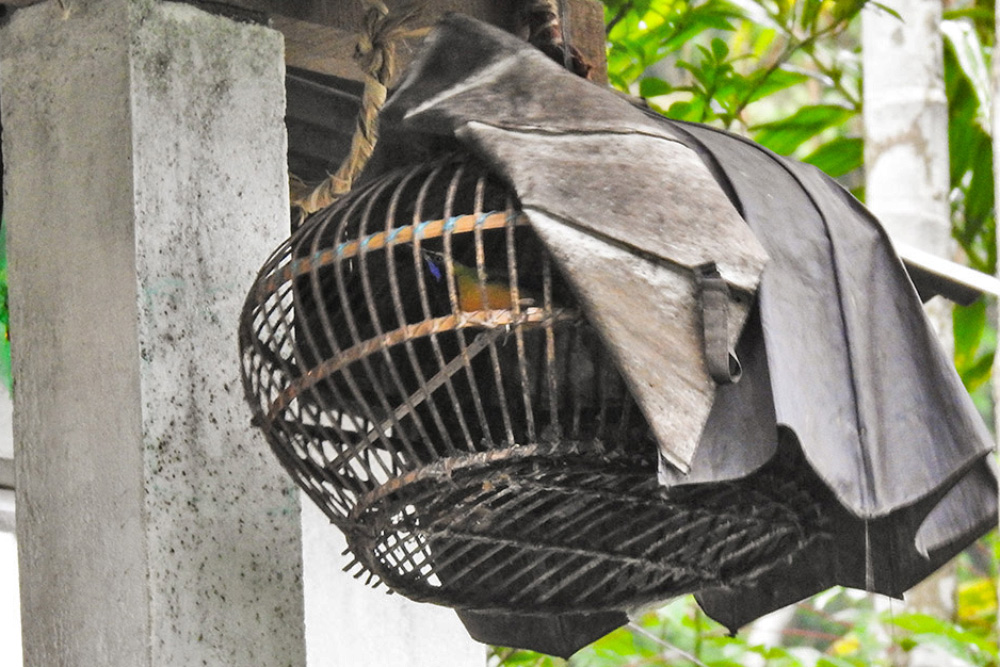
On 25th May 2019, while trekking from the village of Tyrna to Nongriat in the East Khasi hills of Meghalaya, we spotted a partially covered birdcage outside a house near the famous living-root bridge. A closer look through the camera revealed an agitated male orange-bellied leafbird (Chloropsis hardwickii) fluttering from end to end. As we walked a little further, we chanced upon the owner of the house, who casually remarked that it was a pet.
Leafbirds are small, attractive songbirds native to the Indian sub-continent and South-East Asia. Popular in pet markets and songbird competitions, they are commonly traded in many cities of South-East Asia, particularly in Indonesia, Malaysia, Thailand and Singapore.
In India, while hunting of leafbirds is well-documented, especially in Arunachal Pradesh and Nagaland, there are fewer records of these birds in domestic pet-keeping. However, in a survey of frogs conducted in Cherrapunjee in 2004, investigators Hillaljyoti Singha and M. Firoz Ahmed, observed orange-bellied leafbirds, ashy bulbuls and black bulbuls kept as caged birds, in several Khasi households.
In fact, during the same trek we had spotted another such birdcage with a male orange-bellied leafbird, upon reaching the village of Nongriat, thus prompting speculation on whether such domestic wild-bird keeping is incidental or if there is organized trade in caged birds in this region.
References
- Aiyadurai, A. (2011). Bird hunting in Mishmi Hills of Arunachal Pradesh, north-eastern India.
- Choudhury, A.U. (2001). Some bird records from Nagaland, northeast India.
- Chng, S.C., Guciano, M., & Eaton, J.A. (2016). In the market for extinction: Sukahaji, Bandung, Java, Indonesia.
- Chng, S.C., Shepherd, C.R., & Eaton, J.A. (2018). In the market for extinction: birds for sale at selected outlets in Sumatra.
 CI is a non-profit, non-commercial portal that aims to facilitate wildlife and nature conservation by providing reliable information and the tools needed to campaign effectively.

Chosen as 'Picture of the Week'
Since several songbirds were being seen as pets, it prompted speculation whether such domestic wild-bird keeping is incidental or if there is organized trade in caged birds in this region.