
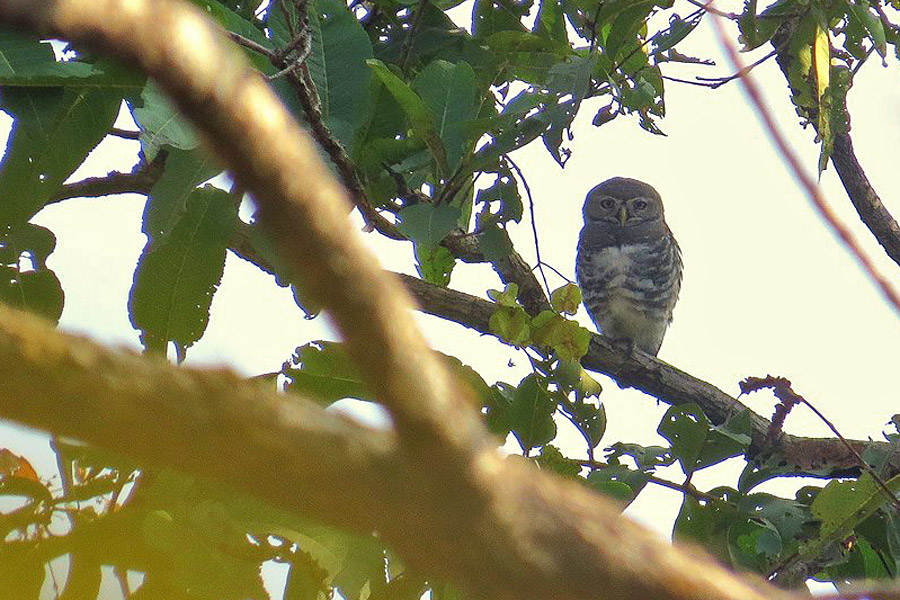
To start the New Year with a bang, Saurabh Sawant, Rujuta Phadke and myself went to Tansa Wildlife Sanctuary near Mumbai where Sunil Laad — a naturalist associated with the Bombay Natural History Society (BNHS) — had sighted and photographed the Critically Endangered Forest Owlet in November 2014.
We had just parked our car to stop and search when, to our incredulity, we heard a Forest Owlet calling. It took us just 10 more minutes to locate a beautiful pair of owlets staring at us. We kept our distance from the birds and watched in amazement as the owlet closed its eyes and took an early-afternoon siesta.
After its original description by A. O. Hume based on a specimen collected by F. R. Blewitt in Madhya Pradesh on 14th December 1872, the Forest Owlet was re-discovered after a gap of 113 years in 1997 by American ornithologists Ben King and Pamela Rasmussen. This species has a tiny, severely fragmented population, known from fewer than 12 recent locations in Central India. However this newfound population of Forest Owlet comes as a new hope for this species. The surveys in suitable habitat between central India and western Maharastra may provide a better understanding of the distribution and population of this species in the future.
Being on the verge of extinction, the Forest Owlet is protected under Schedule I of the Wildlife (Protection) Act 1972, and its hunting or trapping is prohibited in India. It is also listed on CITES Appendix I and II.

 CI is a non-profit, non-commercial portal that aims to facilitate wildlife and nature conservation by providing reliable information and the tools needed to campaign effectively.

Chosen as 'Picture of the Week'
The Forest Owlet has a tiny, severely fragmented population, known from fewer than 12 recent locations in Central India. However, this newfound population near Mumbai comes as a new hope for the the survival of the species.